What Actually Happens During a Full Engine Replacement
Engine replacement in St. Paul is exactly what it sounds like: the old engine comes out, a replacement goes in, and your vehicle gets a second life. It is one of the most involved jobs in automotive repair, but it is not always the last resort people assume it is. For the right vehicle in the right situation, a new or remanufactured engine can cost less than buying a replacement car.
Is Engine Replacement Ever the Right Call?
A lot of people hear "engine replacement" and immediately assume they should just sell the car. That instinct is understandable, but it is not always the right math. If your vehicle has a solid transmission, a clean body, and low miles on everything else, putting a remanufactured engine in it can extend its life by years at a fraction of what a newer vehicle would cost.
The situations that usually lead to this decision are things like a spun bearing, a seized engine from oil starvation, or catastrophic overheating damage. These are failures where the internal components are too far gone to rebuild economically. At that point, a full swap makes more sense than chasing individual repairs.
The honest answer is that it depends on the vehicle. A high-mileage car with rust problems and a failing transmission is probably not worth the investment. But a solid truck or SUV with a single catastrophic engine failure? That is a different conversation entirely.
What Does the Actual Removal Process Look Like?
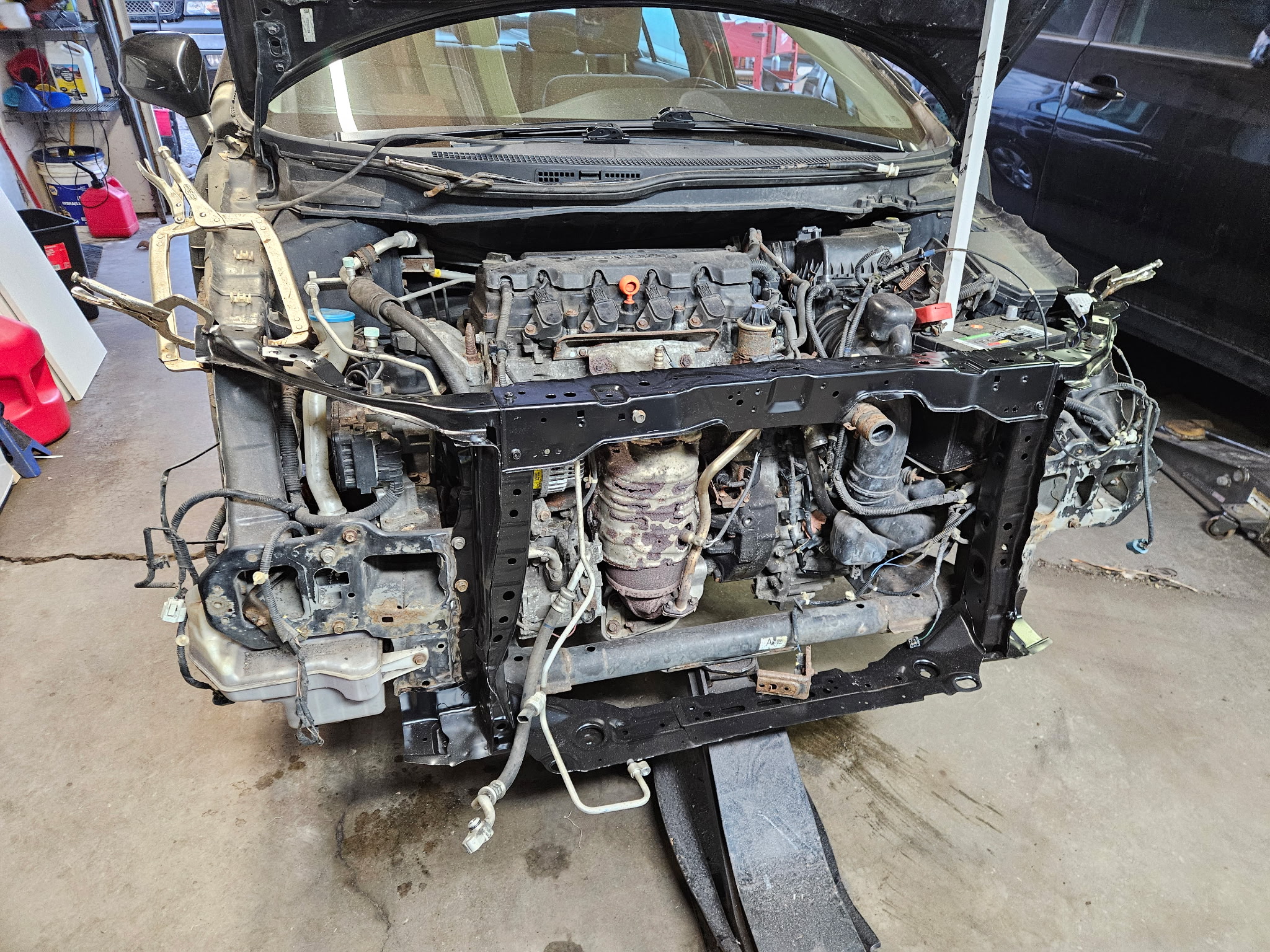
When you see an engine sitting on a drop dolly next to an empty engine bay, it gives you a real sense of the scope involved. The engine bay itself looks almost architectural once the motor is out. You can see the transmission bell housing, the radiator, the motor mounts, and all the supporting structure that normally hides behind the engine block.
Getting to that point takes time and careful disassembly. The mechanic has to disconnect the battery, drain all fluids, remove the hood in most cases, and then systematically disconnect every hose, wire harness, sensor, bracket, and bolt that ties the engine to the vehicle. Depending on the make and model, that list can be surprisingly long.
The engine is then lifted out using a hoist or crane, which is why this job requires proper equipment and not just a set of hand tools. Once the old engine is out, the replacement unit gets prepped. That means transferring over components like the intake manifold, exhaust manifolds, sensors, and sometimes the flywheel or flexplate, depending on what came with the replacement engine.
New, Remanufactured, or Used: Which Engine Goes In?
This is one of the most important decisions in the whole process. A brand new engine from the manufacturer is the most expensive option and is rarely necessary for older vehicles. A remanufactured engine has been rebuilt to factory specs using new or reconditioned parts and typically comes with a warranty. A used engine pulled from a salvage yard is the cheapest option but carries the most risk since you often do not know its history.
Most mechanics will walk you through the tradeoffs based on your vehicle's age, how long you plan to keep it, and your budget. There is no universal right answer, but a remanufactured engine is often the sweet spot between cost and reliability.
Can a Mobile Mechanic Actually Handle an Engine Replacement?
This is the question most people have, and it is a fair one. Engine replacement is not a simple roadside repair. It requires a hoist, proper stands, and enough space to work safely. A mobile mechanic who does this kind of work shows up with the right equipment and handles the job at your location, whether that is your driveway, a parking lot, or wherever the vehicle is sitting.
Backyard Mobile Repair handles engine replacements on-site across the area. The advantage is straightforward: you skip the tow truck, you skip the shop waiting room, and the work gets done where your vehicle already is. For a vehicle that is not driveable, that matters a lot. You can learn more about how the service works by visiting the St. Paul mobile mechanic page.
The job still takes the same amount of time it would at a traditional shop. Nobody is cutting corners because the setting is different. The tools, the process, and the quality of the work are the same. The difference is just the location.
What Happens After the Engine Goes In?
Installation is only part of the job. Once the replacement engine is bolted in and all the connections are made, the mechanic has to refill fluids, check for leaks, and start the vehicle carefully to make sure everything is running correctly. The first startup after an engine swap is always a careful process. You are listening for anything unusual and watching for warning lights or pressure issues.
There is also a break-in period to consider, especially with remanufactured engines. Some manufacturers recommend avoiding hard acceleration for the first several hundred miles to let the new rings seat properly. Your mechanic should walk you through any specific recommendations for the engine that was installed.
If you have questions about whether your vehicle is a good candidate for engine replacement, or you want to understand what the process would look like for your specific situation, the resource hub has additional information on the services Backyard Mobile Repair offers. You can also call (651) 888-9595 any time since the shop operates 24 hours.
How long does an engine replacement take?
Most engine replacements take anywhere from one to three days depending on the vehicle, the type of replacement engine being installed, and how accessible the engine bay is. More complex vehicles with tight engine bays or lots of integrated components can take longer.
Is it worth replacing an engine on a high-mileage vehicle?
It depends on the condition of everything else. If the transmission, body, and other major systems are solid, an engine replacement can make financial sense. If the rest of the vehicle has significant problems, the math usually does not work in your favor.
Can a mobile mechanic do an engine replacement near me?
Yes. Backyard Mobile Repair performs engine replacements on-site in the St. Paul area. The mechanic brings the necessary equipment to your location so you do not need to tow the vehicle to a shop.
What is the difference between a remanufactured and a used engine?
A remanufactured engine has been rebuilt to factory specifications and typically comes with a warranty. A used engine is pulled from a salvage vehicle and sold as-is, which means lower cost but also more uncertainty about its condition and history.
How do I know if my engine needs to be replaced or just repaired?
A mechanic will assess the extent of the damage. Issues like a cracked block, a seized engine, or severe internal damage from oil loss are usually beyond practical repair. Failures that are isolated to specific components may still be repairable without a full swap.
Find us on Google Call (651) 888-9595 anytime.


Comments
Post a Comment